Newsletter Subscribe
Enter your email address below and subscribe to our newsletter


Raised Bed Gardening Made Simple
Category: Grow Your Own
Suggested URL: /how-to-grow-cucumbers-in-raised-garden-beds/
Primary Keyword: How to Grow Cucumbers in Raised Garden Beds
SEO Title: How to Grow Cucumbers in Raised Garden Beds
Meta Description: Learn how to grow cucumbers in raised garden beds, from choosing varieties and planting seeds to trellising, watering, pollination, pest prevention, and harvesting fresh cucumbers.
Cucumbers are one of the most enjoyable summer vegetables to grow in a raised garden bed. Once warm weather arrives, healthy plants can grow quickly, climb several feet, flower heavily, and provide a steady supply of crisp cucumbers.
The biggest challenge is space.
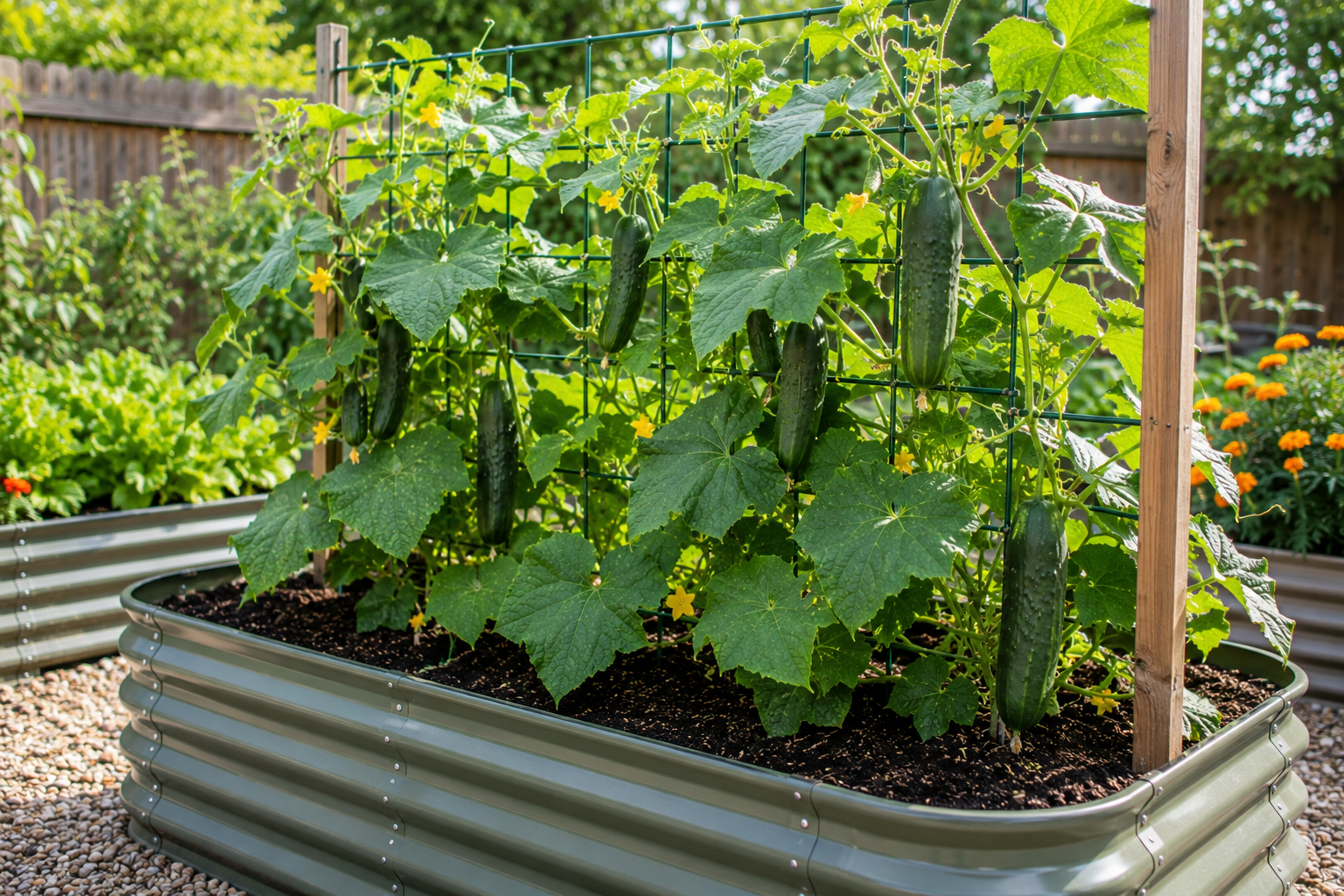
Cucumber vines can spread across a surprisingly large area if left unsupported. In a raised bed, the solution is to plan upward rather than outward.
With the right variety, a sturdy trellis, consistent watering, and regular harvesting, cucumbers can become one of the most productive crops in a small backyard garden.
Before planting, decide how you want to use your cucumbers.
Slicing cucumbers generally produce longer fruits that are ideal for salads and fresh eating.
Pickling cucumbers tend to produce shorter fruits that work well for homemade pickles.
You’ll also find both vining and bush varieties.
Vining cucumbers are excellent for raised beds when you have a trellis. Their vines can climb vertically, leaving valuable soil space available for other vegetables.
Bush varieties remain more compact and may be better for very small beds where installing a tall support isn’t practical.
Always check the mature size of the specific variety rather than assuming all cucumbers grow the same way.
Cucumbers love warmth.
Cold soil and chilly nights can slow their growth, so avoid planting too early simply because spring has arrived.
Wait until frost danger has passed and the soil has warmed.
In many climates, cucumbers can be sown directly into the raised bed because the seeds germinate relatively quickly under suitable conditions.
If you start seedlings indoors, handle them carefully during transplanting. Cucumbers don’t always appreciate unnecessary root disturbance.
Young plants should also be gradually introduced to outdoor conditions before permanent transplanting.
One tiny cucumber seedling can eventually produce several feet of vine.
Spacing therefore matters.
Follow the recommendations for your particular variety, especially if you’re growing several plants along a trellis.
Avoid planting a dense row simply because the bed looks empty at first.
Crowded foliage can reduce airflow, make harvesting more difficult, and create an environment where plant problems are harder to notice.
A smaller number of healthy, well-spaced plants can often be more manageable than an overcrowded bed.
A trellis can completely change how cucumbers use a raised bed.
Instead of allowing vines to cover the soil surface and spill into pathways, guide them upward.
Good support options include:
Install the structure before the plants become large.
Place it securely because mature vines carrying many cucumbers can become surprisingly heavy.
As young vines develop, gently guide them toward the support. Their tendrils will usually begin grabbing onto it naturally.
Don’t think only about supporting the cucumbers—think about the shade the vines will create.
A mature wall of cucumber foliage can block sunlight from smaller vegetables.
Position the trellis where it won’t unnecessarily shade sun-loving crops in the same bed.
On the other hand, that shade can sometimes be useful.
During hot summer conditions, you may be able to grow certain leafy vegetables on the cooler side of the trellis.
This allows one structure to create two different growing environments inside the same raised bed.
Cucumbers contain a lot of water, and productive plants need reliable access to moisture.
Check the soil regularly, especially when vines begin flowering and producing fruit.
Instead of giving the plants frequent tiny splashes, water thoroughly enough to moisten the active root zone.
Try to direct irrigation toward the soil rather than repeatedly wetting the foliage.
A drip line or soaker hose can make this easier when you’re growing multiple plants.
During very hot weather, raised beds may dry faster than expected, so don’t rely entirely on a fixed watering schedule.
Seeing lots of flowers but no cucumbers doesn’t always mean something is wrong.
Many cucumber varieties produce separate male and female flowers.
Male flowers often appear first. Female flowers can be identified by the tiny cucumber-like swelling behind the flower.
Pollinators transfer pollen between flowers, allowing fruit to develop properly.
Encourage bees and other beneficial insects by growing flowering plants nearby and avoiding unnecessary pesticide use.
If small cucumbers begin developing but become misshapen or stop growing, incomplete pollination may be one possible cause.
Cucumbers grow rapidly and can be productive feeders.
Begin with fertile garden soil containing organic matter.
Once plants are established, any additional fertilizer should be selected and applied according to the product instructions and actual plant needs.
Avoid assuming that more nitrogen is always helpful.
Excessive nitrogen may encourage vigorous leafy growth without producing the amount of fruit you expected.
Observe the plants and make measured adjustments instead of repeatedly adding fertilizer.
Cucumber leaves can reveal problems before the fruit does.
Check plants regularly for:
Dense vines can hide problems, so inspect the interior of the plant as well as the outer leaves.
Remove severely damaged material when appropriate and identify the cause before deciding on treatment.
Good spacing and vertical training can also make inspection easier.
One of the most important cucumber-growing habits is also one of the simplest:
Keep picking them.
Cucumbers can grow remarkably quickly during warm weather.
Check the vines frequently once production begins.
Harvest fruits when they reach an appropriate size for the variety rather than allowing every cucumber to become enormous.
Overmature cucumbers can become seedy and less enjoyable to eat.
Regular harvesting can also encourage the plant to continue directing energy toward additional fruit production.
Use clean garden scissors or pruners if necessary instead of aggressively pulling fruit from delicate vines.
Vertically trained cucumbers leave useful space underneath and around the vines.
Depending on your layout, you may be able to combine them with:
Radishes – Quick-growing and compact.
Green onions – Their narrow growth uses little horizontal space.
Lettuce – Can take advantage of partial summer shade in some climates.
Herbs – Certain compact herbs fit easily near bed edges.
Avoid overcrowding simply to maximize the number of plants.
Each crop still needs adequate sunlight, moisture, airflow, and root space.
Raised garden beds are particularly well suited to cucumbers because they make it easy to combine organized spacing with vertical growing.
Choose a variety that matches your space, wait for warm conditions, and install a strong trellis early.
As the plants mature, focus on consistent moisture, healthy foliage, pollinator activity, and regular harvesting.
Most importantly, don’t underestimate how quickly cucumber vines can grow.
A small seedling in early summer can become a large wall of foliage only weeks later.
Plan for that growth from the beginning, and a few well-managed cucumber plants can provide an impressive supply of crisp, fresh cucumbers while using surprisingly little raised-bed space.