Newsletter Subscribe
Enter your email address below and subscribe to our newsletter


Raised Bed Gardening Made Simple
Category: Grow Your Own
Suggested URL: /best-companion-plants-for-raised-garden-beds/
Primary Keyword: Best Companion Plants for Raised Garden Beds
SEO Title: Best Companion Plants for Raised Garden Beds
Meta Description: Discover the best companion plants for raised garden beds. Learn how to combine vegetables, herbs, and flowers to make better use of space and create a diverse, productive garden.
Raised garden beds are perfect for growing more than one type of plant. Instead of filling an entire bed with a single crop, you can combine vegetables, herbs, and flowers to create a more diverse growing space.
This approach is commonly known as companion planting.
Companion planting is sometimes surrounded by exaggerated claims, but the practical idea is simple: choose plants that can share the same space without creating unnecessary competition.
Good combinations can help you use vertical space, attract pollinators and beneficial insects, cover exposed soil, and produce several harvests from one raised bed.
Here are some of the best companion plants to consider.
Basil is one of the easiest herbs to incorporate into a summer vegetable bed.
Its compact growth means it can fit between larger plants without occupying too much room.
Basil is especially convenient near tomatoes and peppers because these crops generally enjoy similar warm, sunny growing conditions.
Instead of planting a large block of basil, place several plants around the bed where they remain easy to reach for harvesting.
Regularly picking the leaves also helps keep the plants manageable.
Marigolds bring color to a vegetable garden while providing flowers that can attract visiting insects.
Their compact size makes them particularly useful around the edges and corners of raised beds.
Rather than using valuable central growing space, plant marigolds where their flowers can spill slightly over the sides.
They look especially attractive beside green leafy vegetables.
While marigolds are often credited with solving many garden pest problems, don’t treat them as a replacement for monitoring your vegetables.
Think of them primarily as a useful flowering addition to a diverse garden.
Nasturtiums are another excellent choice when you want to mix edible plants and flowers.
Their rounded leaves and brightly colored flowers create a different texture from most vegetables.
Depending on the variety, nasturtiums may grow compactly or trail over the edge of the bed.
Trailing varieties are particularly useful because they can occupy space outside the main growing area rather than competing heavily with vegetables in the center.
Both the leaves and flowers are edible and have a distinctive peppery flavor.
Green onions are excellent companions when space is limited.
Because they grow upright and remain relatively narrow, they can fit into gaps that would otherwise remain unused.
Try planting them along the front edge of a raised bed or between larger vegetables.
Their vertical shape creates relatively little shade.
Green onions can work alongside lettuce, peppers, carrots, beets, and many other common garden crops.
They are especially useful when you’re trying to make productive use of a small bed.
Radishes are valuable companion plants because many varieties grow quickly.
Imagine planting tomatoes in spring. The young tomato plants initially occupy relatively little space, even though they will eventually become large.
Radishes can use some of that temporary open ground.
By the time the tomatoes need additional room, your radishes may already be ready for harvesting.
This is an example of succession planting—using the same garden area for different crops at different stages of the season.
Lettuce can fit surprisingly well into mixed raised beds.
Early in the season, it can grow between vegetables that haven’t yet reached their mature size.
Later, taller crops may provide some afternoon shade during warmer weather.
However, don’t bury lettuce beneath an extremely dense canopy.
It still needs adequate light and airflow.
Leaf lettuce is particularly convenient because you can harvest individual leaves rather than waiting for a large head to develop.
Carrots make good use of underground growing space.
Their roots develop vertically while many neighboring vegetables concentrate much of their growth above the soil.
This doesn’t mean carrots require no space, but their growth habit can complement upright vegetables.
Avoid planting them where you will repeatedly disturb the soil around their roots.
Carrots are generally best sown directly in their final growing location.
Dill adds height and fine-textured foliage to a mixed vegetable garden.
When allowed to flower, it can also attract a variety of visiting insects.
Because mature dill can become tall, think carefully about placement.
Position it where it won’t unnecessarily shade shorter sun-loving vegetables.
Dill can also self-seed under suitable conditions, so remove flower heads before seeds mature if you don’t want volunteer plants appearing later.
Parsley is a practical choice for gardeners who want edible herbs mixed among their vegetables.
Its growth is relatively compact, and regular harvesting helps control its size.
Parsley works well near bed edges where you can easily reach it from the pathway.
This is an important part of companion planting that is sometimes overlooked: plants you harvest frequently should be easy to access.
There’s little benefit in hiding your most-used herbs behind large tomato plants.
Sweet alyssum produces masses of small flowers and stays relatively low.
That makes it useful along raised-bed borders.
Its flowers can attract pollinators and other visiting insects while adding visual interest to an edible garden.
Because the plant remains relatively compact, it doesn’t create the same shading issues as taller flowering plants.
Alyssum can also soften the hard edges of wooden or metal raised beds.
Bush beans can be useful when you have a larger raised bed and want a productive vegetable rather than another herb or flower.
Unlike pole beans, bush varieties don’t require a tall trellis.
Their relatively compact shape allows them to occupy their own section beside other vegetables.
However, give them sufficient room rather than squeezing plants into every available gap.
Companion planting should improve garden organization—not create overcrowding.
Chives are another excellent edge plant.
Their narrow leaves take up relatively little space, and established plants can provide repeated harvests.
When allowed to flower, chives produce attractive purple blooms that can bring additional visual interest to the garden.
Because chives are perennial in many climates, think about their long-term location before planting them permanently in a bed that you completely redesign every season.
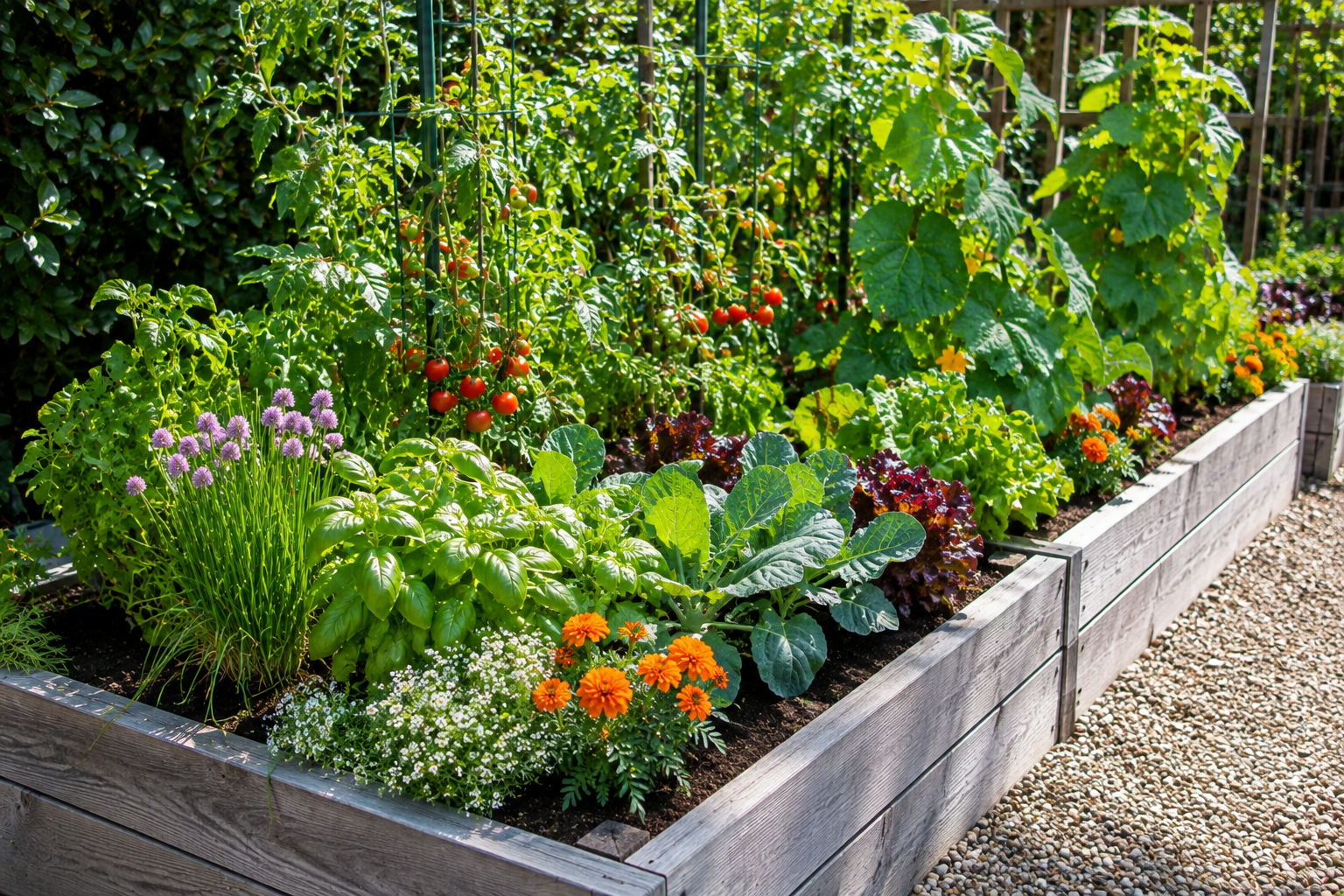
The easiest way to design a mixed raised bed is to think in layers.
Tall layer: Tomatoes, trellised cucumbers, pole beans, or tall herbs.
Medium layer: Peppers, bush beans, kale, or parsley.
Low layer: Lettuce, radishes, green onions, and compact herbs.
Edge layer: Nasturtiums, alyssum, marigolds, or chives.
This arrangement allows you to use more of the available growing space without simply increasing plant density.
Pay attention to the direction of sunlight so taller plants don’t create unwanted shade.
Companion planting isn’t about filling every inch of exposed soil.
All plants still compete to some degree for water, nutrients, light, and root space.
A crowded bed may look productive early in the season but become difficult to manage once plants reach full size.
Always plan according to mature plant dimensions, not the size of seedlings at planting time.
Also leave enough room to reach vegetables for pruning, inspection, and harvesting.
For a simple summer raised bed, you might combine:
Tomatoes + basil + green onions + marigolds
Another option is:
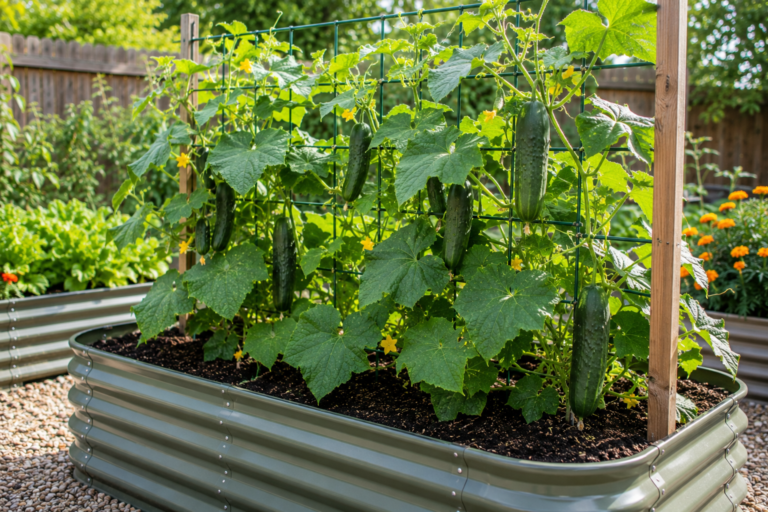
Trellised cucumbers + lettuce + radishes + nasturtiums
For a pepper-focused garden:
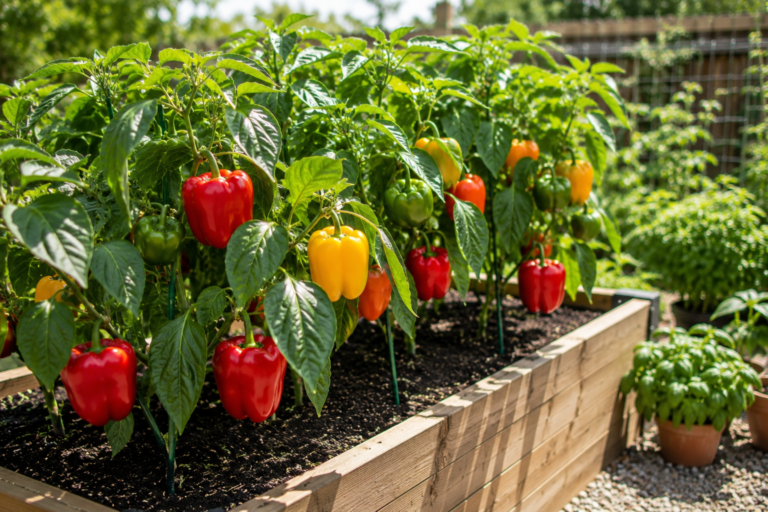
Peppers + parsley + green onions + alyssum
These aren’t strict formulas. Use them as starting points and adjust according to your climate, bed dimensions, and the vegetables your household actually eats.
The best companion plants for raised garden beds are plants that share space efficiently and have compatible growing conditions.
Basil, marigolds, nasturtiums, green onions, radishes, lettuce, carrots, dill, parsley, alyssum, bush beans, and chives can all play useful roles in a mixed garden.
Instead of looking for a magical combination where one plant guarantees the success of another, focus on practical design.
Combine different plant heights, use fast-growing crops before larger vegetables mature, add flowers for biodiversity, and keep frequently harvested herbs near the edges.
Done well, companion planting can turn a simple raised bed into a diverse miniature garden that produces vegetables, herbs, and flowers from the same carefully planned space.