Newsletter Subscribe
Enter your email address below and subscribe to our newsletter


Raised Bed Gardening Made Simple
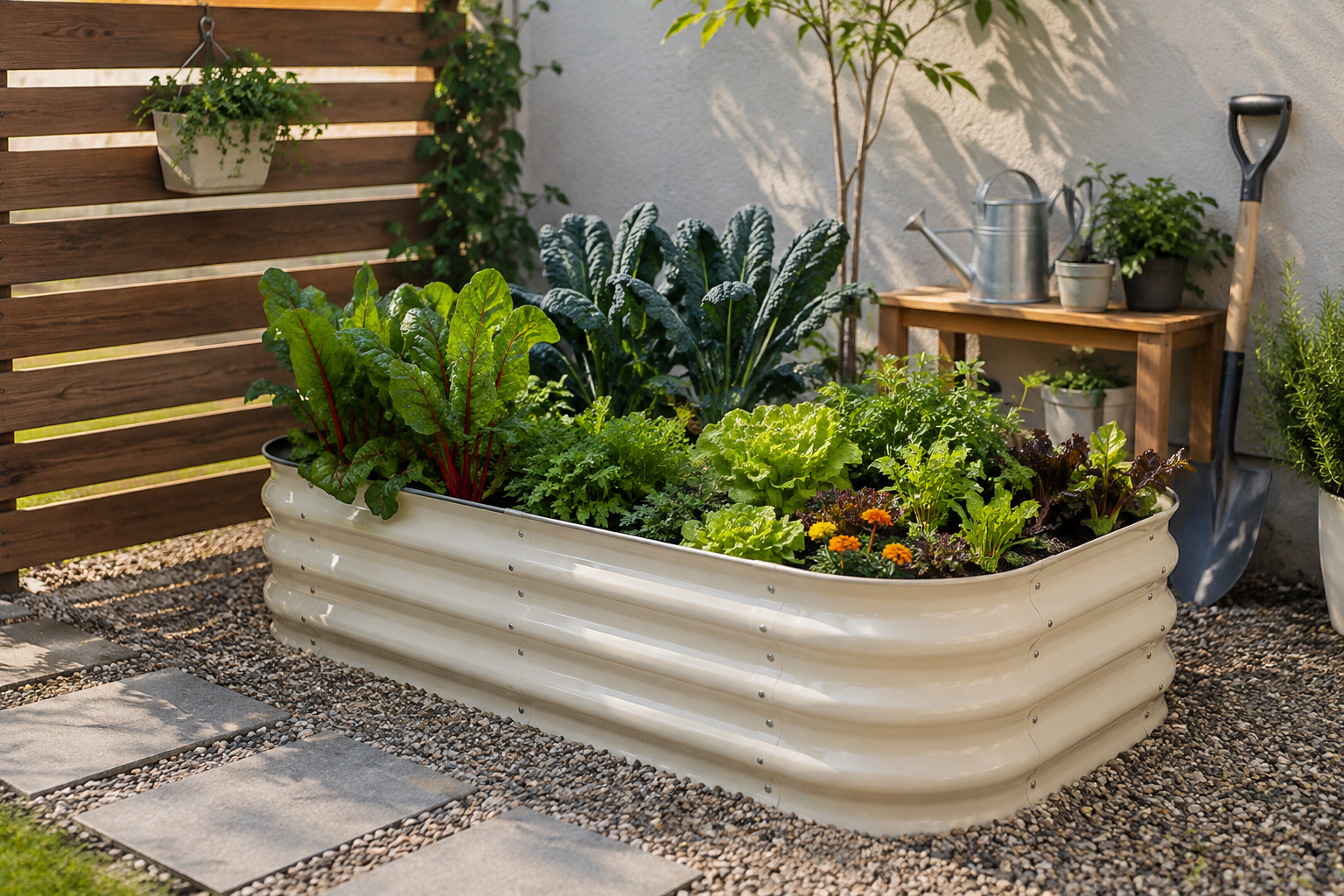
A small backyard does not mean you have to give up on growing vegetables, herbs, or flowers. In fact, raised garden beds can be particularly useful in limited spaces because they create clearly defined growing areas and make it easier to organize your garden.
The challenge is choosing the right size.
A bed that is too large can overwhelm a compact yard and make plants difficult to reach. A bed that is too small may not provide enough growing space for the crops you want.
The best raised garden bed size for a small backyard depends on available space, accessibility, plant selection, and how you plan to move around the garden. Here are several practical sizes worth considering.
A 2 × 4 ft raised bed is one of the most practical options for very small backyards.
Its narrow width makes it easy to reach plants from either side, while the four-foot length provides enough room for several types of vegetables.
This size works particularly well for:
A 2 × 4 bed can also fit beside a fence, patio, shed, or narrow garden path.
If your backyard has awkward unused areas, this compact size can turn them into productive growing spaces without dominating the landscape.
If you have slightly more room, a 3 × 4 ft bed provides additional planting space while remaining relatively compact.
The three-foot width is still comfortable for most gardeners to reach across without stepping into the soil.
This size is useful when you want to grow several crops together. For example, one section could contain leafy greens while another holds herbs or compact vegetables.
It also works well for companion planting because there is enough space to create small planting zones without making the bed difficult to maintain.
The classic 4 × 4 ft raised bed is a good choice for square or moderately sized backyard spaces.
Because the bed can usually be accessed from all four sides, plants near the center remain reachable.
A 4 × 4 bed provides 16 square feet of growing area, which can accommodate a surprisingly diverse garden.
You might use it for a mixture of:
However, avoid placing a 4 × 4 bed directly against a wall or fence. If you cannot access the back side, reaching plants near the far edge can become difficult.
Long, narrow gardens often benefit from a 2 × 6 ft raised bed.
This shape works especially well along fences, walkways, garages, or patio edges.
The narrow width keeps plants accessible, while the additional length creates more growing capacity.
It can also be useful for gardeners who want to grow crops in rows.
For example, you could plant herbs and leafy greens toward the front while placing taller vegetables toward the back.
A 3 × 6 ft bed offers a useful balance between growing capacity and space efficiency.
It provides 18 square feet of planting area but does not feel as bulky as some wider garden beds.
This size can support a mixed vegetable garden with several different crops.
If you want tomatoes or cucumbers, consider placing them along one side with a trellis. Vertical growth allows you to increase production without expanding the footprint of the bed.
This is particularly useful in smaller backyards where horizontal space is limited.
When choosing a raised bed, width is often more important than length.
You should be able to reach the center without stepping into the soil.
For beds accessible from both sides, a width of approximately 3 to 4 feet is practical for many gardeners.
If the bed will sit against a fence or wall and can only be reached from one side, consider keeping it around 2 feet wide.
Length is more flexible.
A bed can often be extended lengthwise as long as you still have enough room to walk around it comfortably.
One common mistake in small backyards is trying to maximize planting space by making the beds too large.
Remember that you also need room to move.
Leave approximately 2 to 3 feet of pathway space where possible.
Wider paths are especially useful if you regularly carry watering cans, compost, tools, or harvesting baskets.
If space is extremely limited, prioritize comfortable access rather than squeezing in another few inches of planting area.
A slightly smaller garden that is easy to maintain is often more useful than a larger garden that is difficult to reach.
Small backyards can become much more productive when vertical growing is included in the design.
Add a trellis to one side of the raised bed for crops such as:
This allows plants to grow upward instead of spreading across valuable soil space.
Place tall structures carefully so they do not shade shorter vegetables for most of the day.
You do not necessarily need one large raised bed.
Two 2 × 4 ft beds, for example, may be easier to arrange than one large bed.
Multiple smaller beds also allow you to separate crops with different growing requirements.
You could create one bed for herbs and leafy vegetables and another for tomatoes and peppers.
Separate beds can also make crop rotation and seasonal replanting easier.
Before choosing dimensions, make a simple list of the vegetables you regularly eat.
If you mainly grow herbs, lettuce, radishes, and green onions, a compact 2 × 4 ft bed may provide plenty of space.
If you want tomatoes, cucumbers, peppers, carrots, and leafy greens together, a 3 × 6 or 4 × 4 ft bed may be more practical.
Avoid choosing the largest bed that physically fits your yard. Choose the smallest size that comfortably supports what you actually plan to grow.
The best raised garden bed sizes for small backyards are usually compact enough to maintain easily while providing sufficient space for useful harvests.
A 2 × 4 ft bed is excellent for very limited spaces, while 3 × 4 ft and 4 × 4 ft beds provide more flexibility for mixed vegetable gardens. Long, narrow 2 × 6 ft or 3 × 6 ft beds can make good use of fences and backyard boundaries.
Whatever size you choose, consider accessibility, pathways, sunlight, and mature plant size before installation.
In a small backyard, smart use of space matters more than simply building the largest possible bed. A carefully positioned compact raised bed can provide an organized, attractive, and productive garden without taking over the entire yard.