Newsletter Subscribe
Enter your email address below and subscribe to our newsletter


Raised Bed Gardening Made Simple
Category: Raised Bed Guides
Suggested URL: /where-to-place-a-raised-garden-bed/
Primary Keyword: Where Should You Place a Raised Garden Bed
SEO Title: Where Should You Place a Raised Garden Bed?
Meta Description: Find the best location for a raised garden bed. Learn how sunlight, drainage, orientation, water access, trees, pathways, and seasonal conditions affect where you should build your garden.
Choosing the right location for a raised garden bed can be just as important as choosing the bed itself.
Once a large raised bed is filled with soil, moving it becomes difficult. That’s why it’s worth spending some time studying your backyard before installation.
The ideal location should provide enough sunlight for your plants while also offering good drainage, convenient access, and protection from unnecessary competition or shade.
Here are the most important factors to consider when deciding where your raised garden bed should go.
For most vegetable gardens, sunlight should be your first consideration.
Popular crops such as tomatoes, peppers, cucumbers, squash, and beans generally perform best in locations receiving plenty of direct sunlight.
Look for an area that receives around six to eight hours of direct sun per day during the growing season.
However, don’t judge sunlight based on a single moment.
An area that looks sunny at 10 a.m. may be shaded by your house or trees later in the afternoon.
Observe your backyard at several times during the day before choosing a permanent location.
The sun’s position changes throughout the year.
A location that receives excellent sunlight in midsummer may behave differently during spring or fall.
Trees also create changing conditions. A deciduous tree without leaves in early spring may allow plenty of light, but its canopy can create significant shade by summer.
If possible, think about when you expect to use the bed most.
A garden intended primarily for summer tomatoes has different sunlight priorities from one designed for cool-season lettuce and spinach.
For many backyard gardens, bed orientation is less important than simply receiving adequate sunlight.
Still, orientation can become useful when you have a long rectangular bed.
A north-south orientation can help distribute sunlight across plants as the sun moves through the sky, although local conditions, surrounding structures, and crop height also matter.
More importantly, think about where you place tall plants.
Tomatoes on cages, pole beans on trellises, and climbing cucumbers can cast substantial shadows.
Position tall crops where they are less likely to block sunlight from shorter vegetables.
A large tree can create a beautiful garden backdrop, but directly underneath it isn’t necessarily the best place for vegetables.
Trees may compete with your raised bed for sunlight and water.
Their roots can also extend surprisingly far beyond the visible canopy.
An open-bottom raised bed installed near aggressive tree roots may eventually experience roots growing into the rich, moist soil inside the bed.
If possible, leave reasonable distance between vegetable beds and large established trees.
This also reduces problems from falling branches and excessive leaf litter.
Before building your garden, inspect the proposed location after heavy rainfall.
Does water disappear normally, or does the area remain wet for hours or days?
A raised bed can improve growing conditions above poor native soil, but placing it directly in a persistent drainage problem isn’t ideal.
Standing water around the base can make pathways muddy and create maintenance issues.
Look for relatively well-drained ground where rainwater naturally moves away rather than collecting.
Vegetables need regular watering, particularly during hot and dry periods.
A beautiful location at the far end of a large property may become inconvenient if you have to carry watering cans there every day.
Before installing the bed, think about your irrigation plan.
Can a garden hose comfortably reach the area?
Could you install a drip irrigation line?
Is there a nearby outdoor faucet?
Convenient access to water makes regular garden maintenance much easier.
Gardens tend to receive better care when they’re easy to see.
A raised bed positioned somewhere you regularly walk past makes it easier to notice:
You may also harvest vegetables more frequently when the garden is conveniently located near your home.
An unused corner of the property isn’t always the best garden location simply because nothing else is there.
Don’t place a raised bed tightly between fences, walls, or other garden structures without considering access.
You need enough room to walk, kneel, weed, harvest, and use garden tools.
For beds that require access from both sides, leave comfortable pathways around them.
Also consider the width of the bed itself.
If you can’t reach the center without stepping into the soil, routine maintenance becomes inconvenient.
Planning pathways at the same time as bed placement creates a much more practical garden.
A fence can provide useful support and protection, but it can also create shade.
The effect depends on the direction the fence faces, its height, and the sun’s path across your property.
Walls introduce another consideration: heat.
Some masonry surfaces absorb solar energy during the day and release heat later.
This may create a warmer microclimate nearby.
That can sometimes be useful, but during very hot summers it may also increase stress on certain plants.
Observe the area before committing to it.
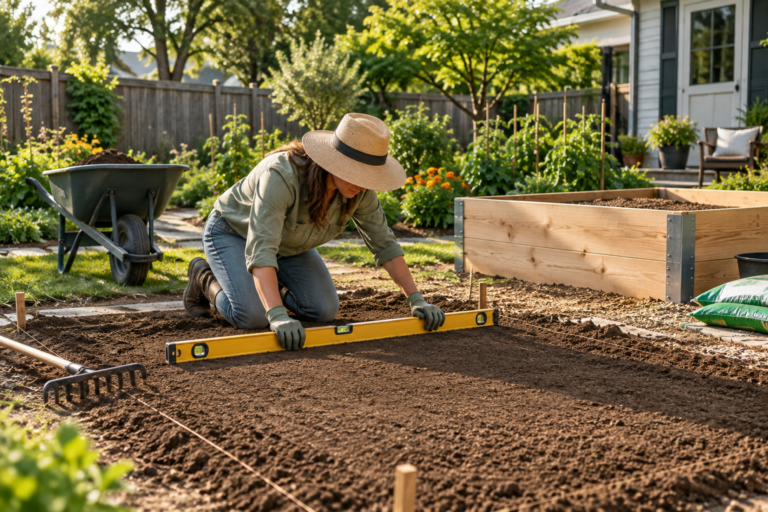
A gentle slope doesn’t automatically prevent you from using raised beds.
However, the bed itself should be installed securely and kept reasonably level.
A significantly tilted bed can lead to uneven soil depth and inconsistent water distribution.
You may need to level the installation area or create a small terrace before placing the frame.
Avoid simply setting a large bed on a steep slope and hoping the soil will compensate.
Think about who else uses your backyard.
If dogs regularly run through a particular area, placing a vegetable bed directly in their path may create problems.
Likewise, if deer, rabbits, or other wildlife frequently visit your property, consider how you’ll protect the garden.
You may need enough surrounding space for fencing, netting, hoops, or other protective structures.
Planning for these additions before filling the bed is much easier than redesigning everything later.
You may begin with one raised bed and eventually want three or four.
Before installing the first one, imagine what the garden could look like in several years.
Could another bed fit beside it?
Is there room for pathways?
Could you add a trellis, compost area, irrigation system, or small potting station?
Leaving some flexibility around your first bed can make future expansion easier.
Before choosing your final location, ask:
If the location performs well in most of these areas, you’ve probably found a good place to start.
The best place for a raised garden bed isn’t necessarily the prettiest empty corner of your backyard.
For most vegetable gardens, prioritize a location with good sunlight, reliable drainage, convenient water access, and enough room to work comfortably around the bed.
Avoid areas dominated by large tree roots or heavy shade, and think about how fences, buildings, and tall plants will affect sunlight throughout the season.
Most importantly, choose the location before filling the bed.
Once hundreds of pounds of soil are inside, changing your mind becomes much harder.
Spend a day observing your backyard first. Watch the sunlight, check drainage, measure your pathways, and think about how you’ll water the plants.
A well-positioned raised garden bed can make planting, maintenance, and harvesting easier for many growing seasons to come.