Newsletter Subscribe
Enter your email address below and subscribe to our newsletter
Raised Bed Gardening Made Simple
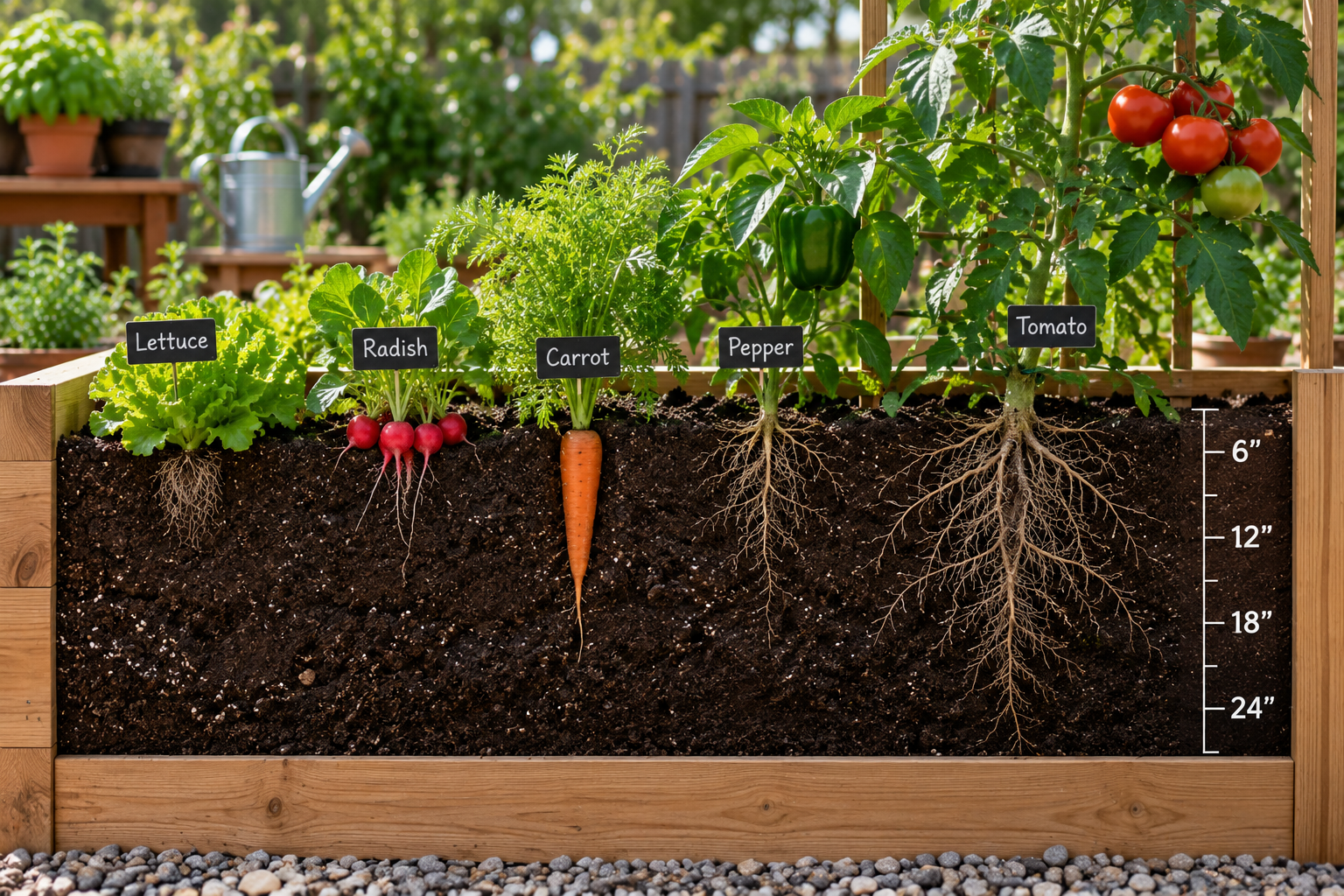
One of the first decisions when building a vegetable garden is determining the depth of the raised bed. While it is tempting to assume that deeper is always better, vegetable roots vary considerably in how much soil they actually use.
A bed that is too shallow can restrict certain crops, particularly when it sits over concrete or compacted ground. But an unnecessarily deep bed requires substantially more soil, increases construction costs, and may require more careful moisture management.
For many home vegetable gardens, 12 to 18 inches is a practical raised-bed depth. However, the best choice depends on what you plan to grow and whether plant roots can continue into the native soil below.
For many vegetables, yes.
Utah State University Extension recommends raised-bed boxes at least 6 to 12 inches high to accommodate the rooting depth of most vegetables. When beds are less than 12 inches deep, USU recommends leaving the bottom open so roots can continue into the soil underneath.
Shallow-rooted crops can perform particularly well in approximately 6–12 inches of usable soil.
These include crops such as:
USU classifies these vegetables as having an effective root depth of roughly 6–12 inches.
Remember that effective root depth does not mean no roots grow deeper. It refers to the zone containing the bulk of the functional root system.
There is no single perfect depth for every crop. A better approach is to design your bed around the vegetables you expect to grow most often.
| Vegetable Type | Examples | Effective Root Depth* | Practical Bed Consideration |
|---|---|---|---|
| Leafy greens | Lettuce, spinach, chard | 6–12 in | 10–12 in is often practical |
| Alliums | Onion, garlic | 6–12 in | Suitable for relatively shallow beds |
| Brassicas | Broccoli, kale, kohlrabi | 6–12 in | Allow adequate spacing as plants mature |
| Peppers | Bell and hot peppers | 6–12 in | 12+ in provides useful soil volume |
| Root vegetables | Carrots, beets, turnips | 18–24 in | Loose soil below the bed is especially valuable |
| Fruiting vegetables | Tomatoes, eggplants | 18–24 in | Deeper soil provides a larger root and moisture reservoir |
| Vining crops | Cucumbers, summer squash | 18–24 in | Combine adequate depth with horizontal/vertical space |
| Legumes | Beans, peas | 18–24 in | Open-bottom beds allow deeper rooting |
*Effective root-depth categories are based on Utah State University Extension guidance; actual rooting varies with cultivar, soil conditions, irrigation, and whether crops are direct-seeded or transplanted.
This table should therefore be treated as a planning guide rather than a rigid construction rule.
A 12-inch raised bed sitting over healthy garden soil is very different from a 12-inch planter sitting on concrete.
Traditional raised beds are usually open at the bottom.
This allows roots to move below the frame and access additional soil, water, and nutrients. USU specifically notes that this is an important difference between raised beds and container gardens.
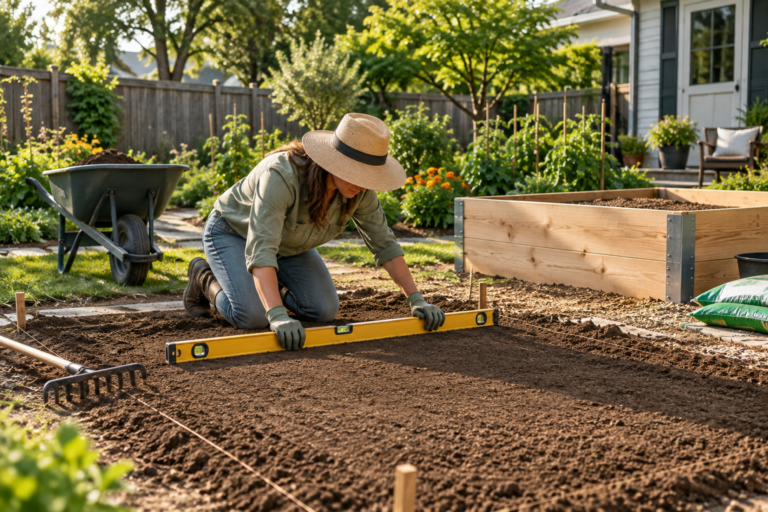
If your bed sits over existing soil, loosen the ground underneath before filling it.
USU recommends tilling or loosening approximately 6–12 inches of soil below shallow raised beds, while Oregon State University suggests loosening native soil beneath framed beds to encourage deeper root growth.
This effectively increases the usable rooting zone without requiring you to fill the entire depth with purchased raised-bed mix.
This situation requires different planning.
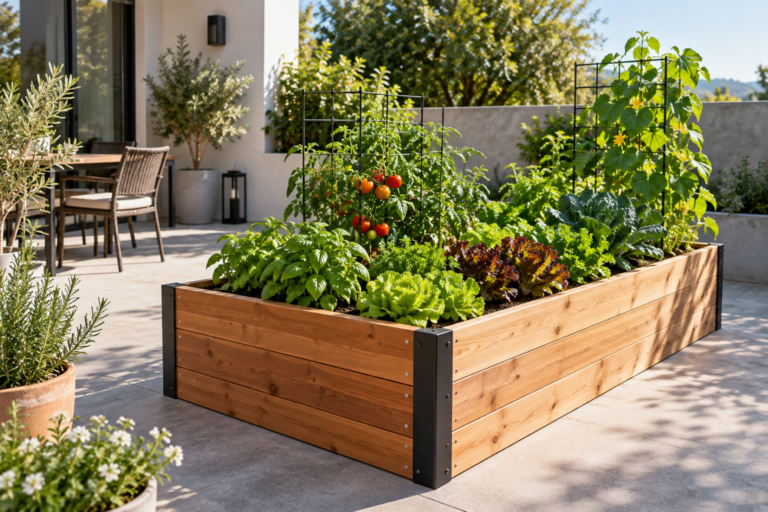
If your raised bed sits on concrete, a patio, or another impenetrable surface, roots cannot continue downward.
The bed behaves more like a very large container.
For that reason, I would generally avoid very shallow beds for mixed vegetable production on concrete. A deeper bed gives crops a larger reservoir for roots, moisture, and nutrients.
USU’s container guidance gives a useful comparison: approximately 6–8 inches for leafy vegetables, 8–14 inches for root vegetables, and 12–16 inches for fruiting vegetables.
Drainage also becomes particularly important.
Water must have a reliable way to escape rather than collecting at the bottom.
An 18-inch bed is a useful all-purpose choice when you want flexibility.
It provides more soil volume for larger crops while still being manageable for most home gardens.
Consider approximately 18 inches when:
USU describes raised beds as commonly being around 12–18 inches deep, although shallower designs are possible.
There is still no need to make every vegetable bed 18 inches deep if you mainly grow lettuce, herbs, radishes, and onions over good native soil.
Not necessarily.
USU categorizes tomatoes as having an effective root depth of approximately 18–24 inches.
But that does not automatically mean the wooden or metal frame itself must be 24 inches tall.
If you have a 12–18-inch open-bottom bed over loose, healthy native soil, tomato roots can continue below the frame.
A deeper self-contained bed becomes more useful when the soil underneath is inaccessible or unsuitable for root growth.
This distinction can save a significant amount of soil.
Carrots are a good example of why bed depth alone can be misleading.
A deep bed filled with dense, compacted soil is not necessarily better than a moderately deep bed containing loose, workable soil.
USU places carrots, beets, and turnips in its moderate 18–24-inch effective rooting category.
University of Minnesota Extension recommends loosening soil at least six inches for ordinary radishes and considerably deeper for long varieties such as daikon.
For root vegetables, therefore, prioritize both usable depth and soil structure.
Before choosing a 24-inch bed instead of a 12-inch bed, calculate the difference in volume.
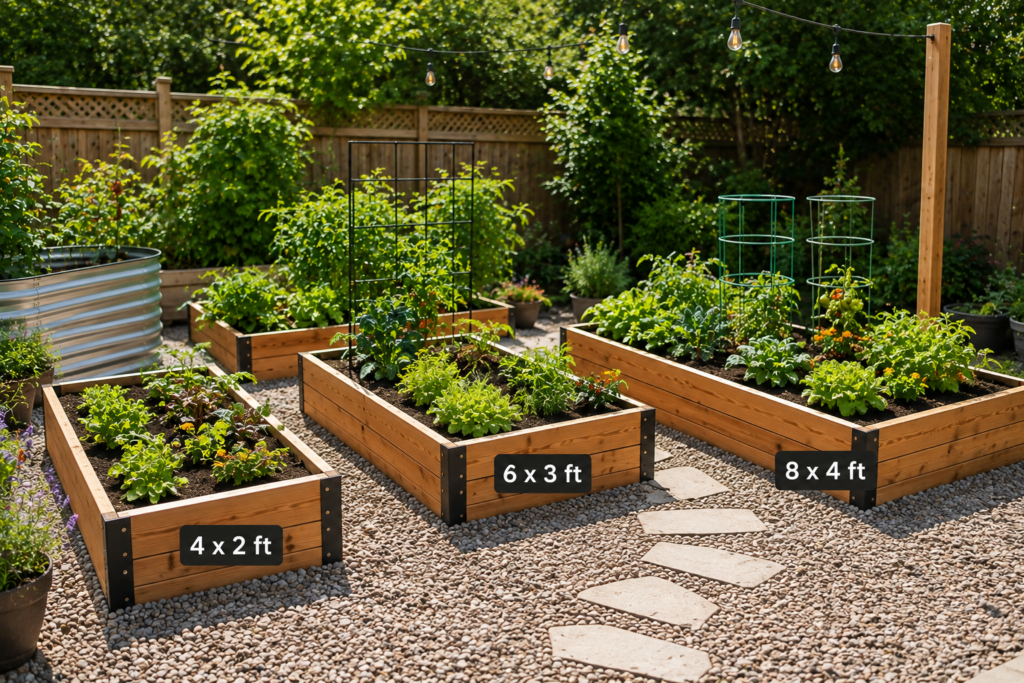
For example, a standard 4 × 8-foot bed requires approximately:
12 inches deep: 32 cubic feet
18 inches deep: 48 cubic feet
24 inches deep: 64 cubic feet
Doubling the depth from 12 to 24 inches doubles the volume that needs filling.
That affects not only initial soil cost but also the physical load placed on the frame.
Oregon State University recommends reinforcing framed beds taller than about 18 inches, particularly larger structures, because wet soil creates substantial outward pressure.
Deeper is not automatically easier.
Raised beds tend to behave somewhat like containers, and moisture conditions can differ from surrounding garden soil. University of Minnesota Extension notes that raised beds can dry more quickly, with taller beds potentially requiring more frequent watering.
Oregon State University also warns that deeper beds require good drainage and that filling deep beds with poorly draining, unamended soil can negatively affect plant growth.
Whatever depth you choose, use a soil mixture that balances drainage with moisture retention.
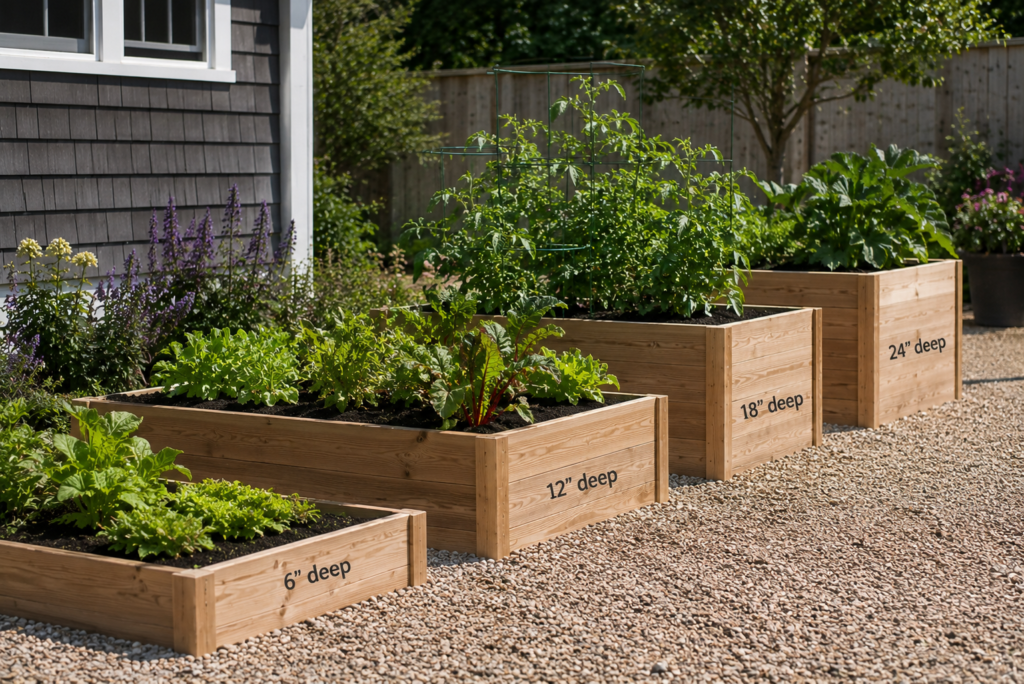
For a typical backyard vegetable garden, these are useful starting points:
6–10 inches: primarily shallow-rooted vegetables over good native soil.
12 inches: a practical minimum for many mixed vegetable gardens, especially with an open bottom.
12–18 inches: a versatile range for gardeners growing several types of vegetables.
18–24 inches: useful for deeper-rooted crops, poor underlying soil, hard surfaces, or gardeners who prefer a taller working height.
If you are unsure what you will grow in future seasons, 12–18 inches is usually the most flexible range.
So, how deep should a raised garden bed be for vegetables?
There is no universal depth that is perfect for every crop.
For many backyard gardens, a 12–18-inch raised bed provides a practical balance between rooting space, soil cost, construction requirements, and crop flexibility. Shallower beds can successfully support many vegetables when they are open to healthy soil below, while deeper beds become more valuable when growing over concrete, compacted ground, or other restrictive surfaces.
Most importantly, do not judge a raised bed only by the height of its frame.
Consider the total usable rooting zone—the raised-bed soil plus any loose, accessible soil underneath.
A 12-inch bed over healthy, loosened ground can sometimes offer plants more useful rooting space than a deeper box filled with poorly structured soil.