Newsletter Subscribe
Enter your email address below and subscribe to our newsletter


Raised Bed Gardening Made Simple
When planning several raised garden beds, gardeners often spend more time deciding the length and width of each bed than thinking about the space between them.
That space matters just as much.
Paths that are too narrow can make watering, harvesting, carrying compost, and using a wheelbarrow frustrating. Extremely wide paths, however, can take valuable space away from your growing area.
So, how far apart should raised garden beds be?
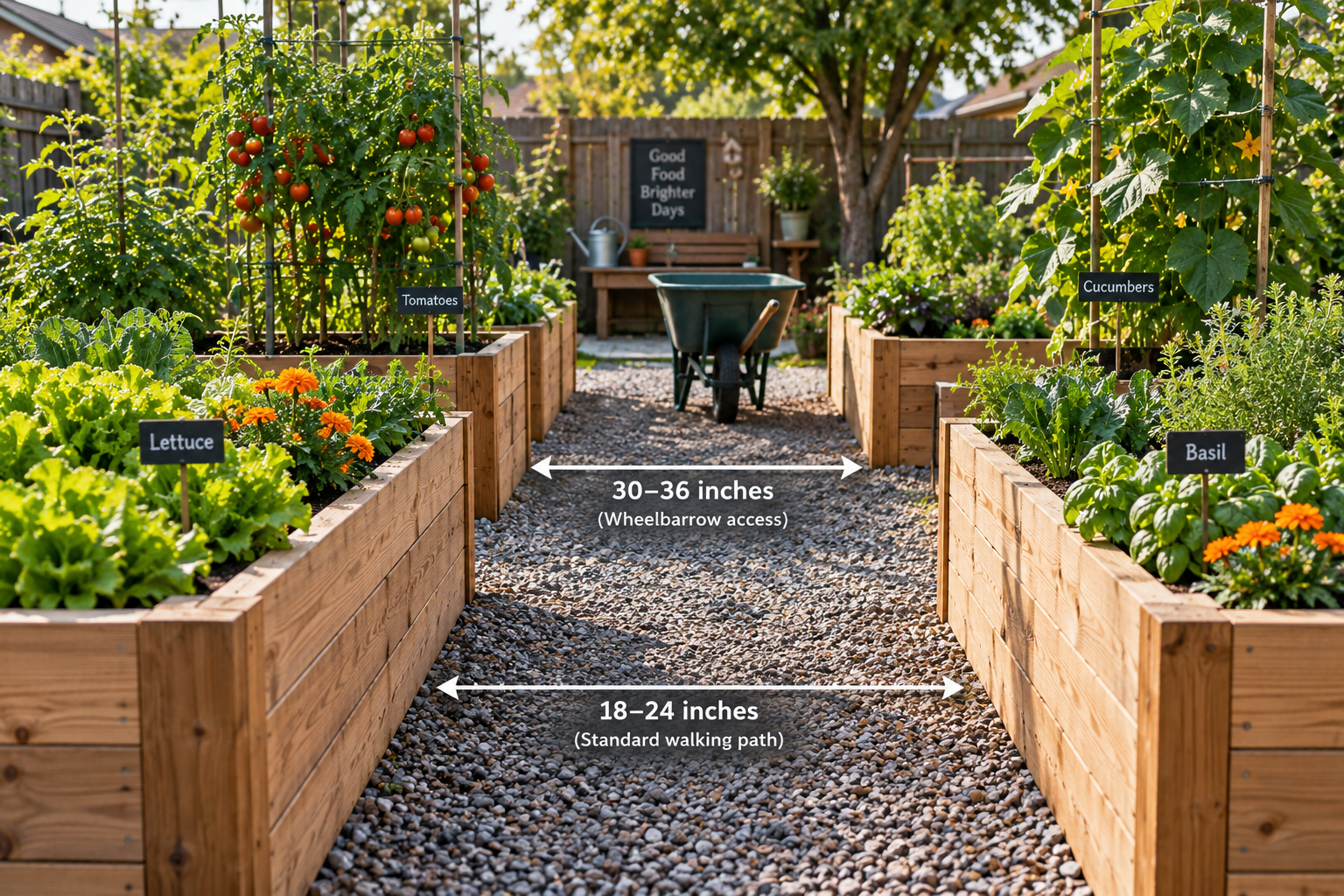
For most backyard gardens, leaving approximately 18 to 24 inches between beds is a reasonable starting point for basic walking access. If you regularly use a wheelbarrow, cart, or other garden equipment, approximately 30 to 48 inches may be much more practical.
The right answer depends on how you intend to use the garden.
It can be.
UF/IFAS Extension recommends leaving about 18–24 inches between raised beds and suggests approximately 30-inch walkways when a wheelbarrow will be used.
University of Georgia Cooperative Extension provides similar guidance. It identifies 12 inches as an absolute minimum in very tight spaces but says 18–24 inches provides more comfortable access.
For a small backyard where maximizing planting area is important, an 18-inch path may work between beds that are primarily accessed on foot.
But there is an important catch: plants do not always remain inside the frame.
Squash leaves, tomatoes, cucumbers, herbs, and flowers can extend into pathways as the season progresses. Missouri Extension specifically notes that plants growing near bed edges can hang into pathways and reduce the usable walking width.
A path that feels adequate in spring may become surprisingly narrow by midsummer.
| Garden Use | Suggested Path Width | Best For | Main Consideration |
|---|---|---|---|
| Very limited space | 12–18 in | Occasional foot traffic | Can feel tight as plants mature |
| Normal walking | 18–24 in | Small backyard gardens | Good balance of access and growing area |
| Wheelbarrow/cart | 30–36+ in | Compost, soil and harvest transport | Allows easier equipment movement |
| Main garden walkway | 36–48 in | Frequently used routes | Easier turning and carrying |
| Wheelchair access | About 48 in | Accessible garden design | Surface and turning space also matter |
These numbers are planning ranges rather than universal construction rules. UGA recommends up to 4 feet between beds where carts, wheelbarrows, and wheelchairs need access, while Oregon State University recommends 3–4-foot paths for wheelchairs and wheelbarrows.
If you regularly move compost, mulch, soil, or harvested vegetables, design your pathways around your equipment.
Do this before building the beds.
Missouri Extension recommends approximately 2–3 feet for a wheelbarrow or garden cart. Iowa State University Extension similarly recommends roughly 3-foot pathways between adjacent beds when garden equipment such as a wheelbarrow or cart will be used.
Measure your actual wheelbarrow if possible.
Then add enough clearance for your hands, elbows, plants extending from the beds, and turning at the end of the path.
Passing through a pathway and comfortably working in it are two different things.
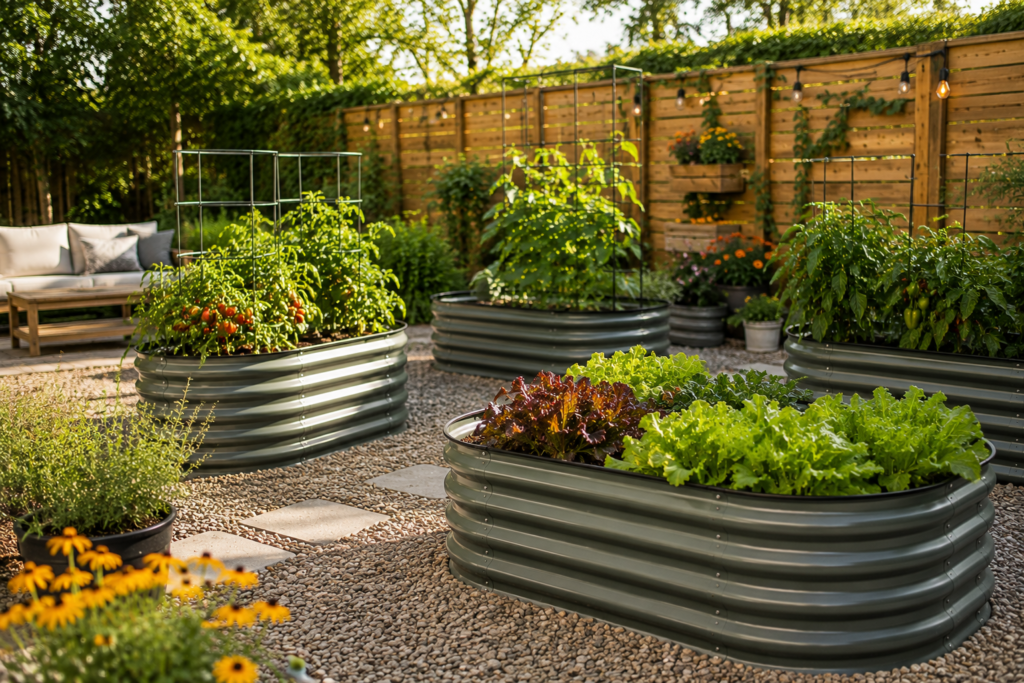
One of the best ways to save backyard space is to use different widths for different paths.
For example, you might create:
Secondary paths: 18–24 inches
Working paths: approximately 30–36 inches
Main path: approximately 36–48 inches
This allows you to preserve more planting area without sacrificing equipment access.
A central wider pathway is particularly useful because it can act as the main route for wheelbarrows, compost bags, watering equipment, and harvesting baskets.
UGA Extension recommends considering a wider central path when laying out multiple raised beds.
Path spacing cannot be planned independently from bed width.
Most raised beds are designed so gardeners can reach the center without stepping into the soil.
Clemson Cooperative Extension recommends beds approximately 3–4 feet wide, allowing gardeners to work from both sides while keeping foot traffic out of the growing area.
Colorado State University Extension gives similar advice, recommending planting beds approximately 3–4 feet wide so the center remains reachable from pathways.
This is important because one of the benefits of raised beds is reduced soil compaction.
If your beds are so wide—or your pathways so poorly positioned—that you regularly need to step into them, the layout is working against that advantage.
Do not measure spacing based only on empty beds.
Imagine the garden in July or August.
A tomato plant may extend well beyond the frame. Cucumber vines can escape their trellis. Squash leaves may spread across pathways.
If two beds are only 18 inches apart and both contain sprawling crops along their edges, the usable pathway may almost disappear.
Place compact vegetables near narrower paths and give more aggressive crops enough room.
You can also use trellises to keep climbing plants growing upward instead of outward.
Spacing is mainly an accessibility decision, but sunlight also matters.
Tall raised beds, trellises, and mature plants can cast shadows onto neighboring beds.
UGA Extension notes that tall crops can shade shorter plants in nearby beds when beds are close together, particularly depending on orientation. Where practical, it suggests considering a north–south layout.
However, orientation should not be treated as an absolute rule.
Colorado State University Extension notes that orientation advantages can vary and recommends choosing an arrangement that works well for the actual landscape.
Observe your site’s sun exposure before construction, especially if you plan to use tall trellises.
Pathways also need room for irrigation maintenance.
Drip lines, hoses, connectors, and watering equipment should be accessible without forcing you to climb between plants.
Straight, organized beds can simplify irrigation installation. UGA Extension specifically notes that orderly bed layouts make drip irrigation easier to install and make hand-watering routes more manageable.
If you drag a hose through the garden, consider slightly wider main pathways and protect bed corners so the hose does not damage plants.
For wheelchair or mobility-aid access, ordinary 18-inch pathways are not sufficient.
Oregon State University recommends 3–4-foot-wide, smooth, level pathways for wheelchairs and wheelbarrows. It also emphasizes firm surfaces and clutter-free routes.
UGA recommends approximately 4 feet between beds when pathways need to accommodate carts, wheelbarrows, or wheelchairs.
Width is only one part of accessible garden design.
Surface stability, turning areas, bed height, reach distance, and slope should also be considered.
Your pathway material can influence the spacing you need.
Common options include:
If you intend to mow grass between beds, measure your mower before construction.
If you use gravel or mulch, consider edging so pathway material does not constantly migrate into the beds.
For wheelchair access, OSU recommends firm, stable surfaces such as concrete, asphalt, compacted gravel, patio blocks, or other appropriately maintained hard surfaces.
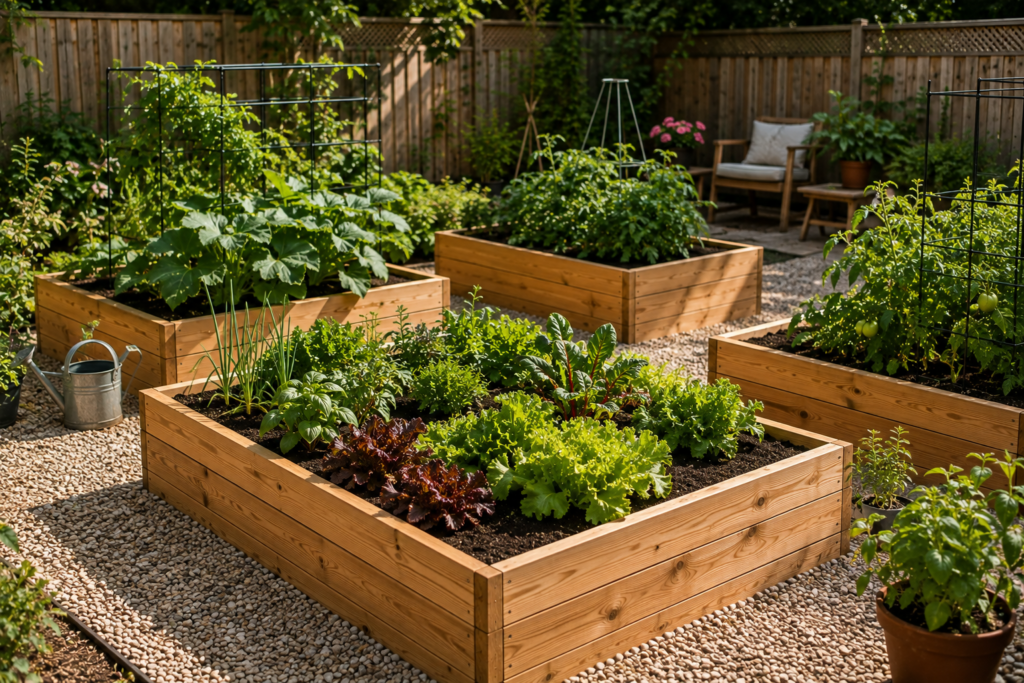
Suppose you are installing four standard 4 × 8-foot raised beds.
Rather than automatically spacing every bed 4 feet apart, you could use approximately:
24-inch secondary paths between beds for normal walking.
36–48-inch main path through the center for moving soil, compost, and garden equipment.
Leave adequate space around the outer perimeter so you can reach every side that needs maintenance.
This approach gives you comfortable access without unnecessarily turning a large portion of the backyard into pathways.
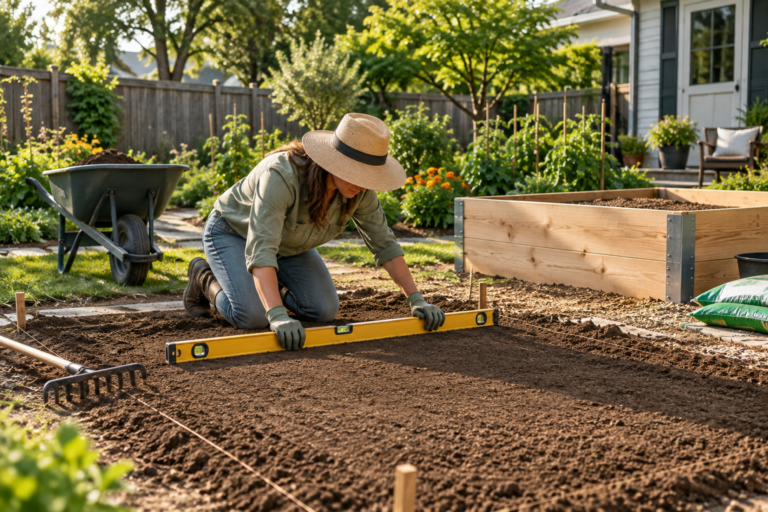
Before construction, mark the beds and paths using stakes, string, cardboard, or landscape paint.
Then physically walk through the proposed layout.
Carry a basket through it. Push your wheelbarrow through it. Kneel beside an imaginary bed.
This simple test often reveals problems that measurements alone do not.
So, how far apart should raised garden beds be?
For many home gardens, 18–24 inches is a practical starting range for ordinary walking paths. If you regularly use a wheelbarrow or cart, consider approximately 30–36 inches or more, while major or accessible pathways may benefit from 36–48 inches depending on the user’s needs and equipment. These ranges align with guidance from multiple university Extension programs, although their exact recommendations vary according to intended use.
Do not choose spacing based only on how the empty garden looks.
Think about mature plant size, wheelbarrow access, irrigation, sunlight, pathway surfaces, and how you will actually work in the garden.
A slightly wider pathway may sacrifice a small amount of planting area, but if it makes planting, weeding, watering, and harvesting significantly easier, that space is not wasted—it is part of a functional raised-bed garden.