Newsletter Subscribe
Enter your email address below and subscribe to our newsletter


Raised Bed Gardening Made Simple
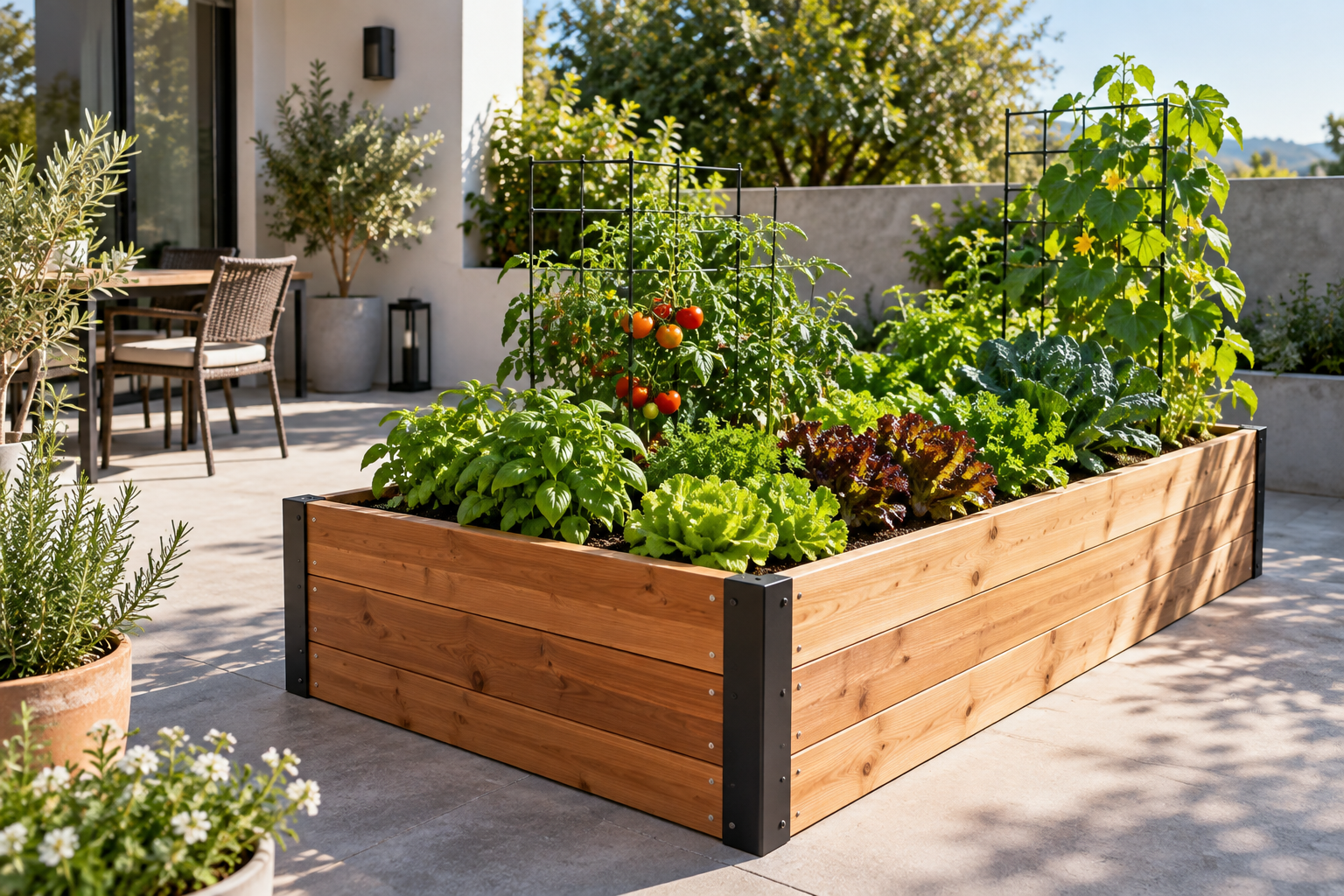
A concrete patio, driveway, or paved backyard does not have to prevent you from growing vegetables. A properly designed raised garden bed can work well on a hard surface, but it needs to be treated differently from a bed built over native soil.
The biggest differences are rooting depth, drainage, heat, and irrigation. On ordinary ground, roots may grow beyond the bottom of a raised bed into the soil below. On concrete, they cannot. University of Maryland Extension specifically notes that raised beds can be used on hard surfaces such as pavement, but recommends providing enough soil depth for the crops being grown.
Here is how to build one correctly.
Before building the frame, evaluate the concrete area.
Most vegetables perform best with substantial direct sunlight. Utah State University Extension recommends 6–8 hours of direct daily sunlight for maximum fruit and foliage production in raised beds.
Also check the slope of the concrete. A slight slope can help water move away, but a strongly uneven surface can make the bed unstable and cause water to collect on one side.
Avoid positioning the bed where roof runoff or downspouts dump large volumes of water directly into it.
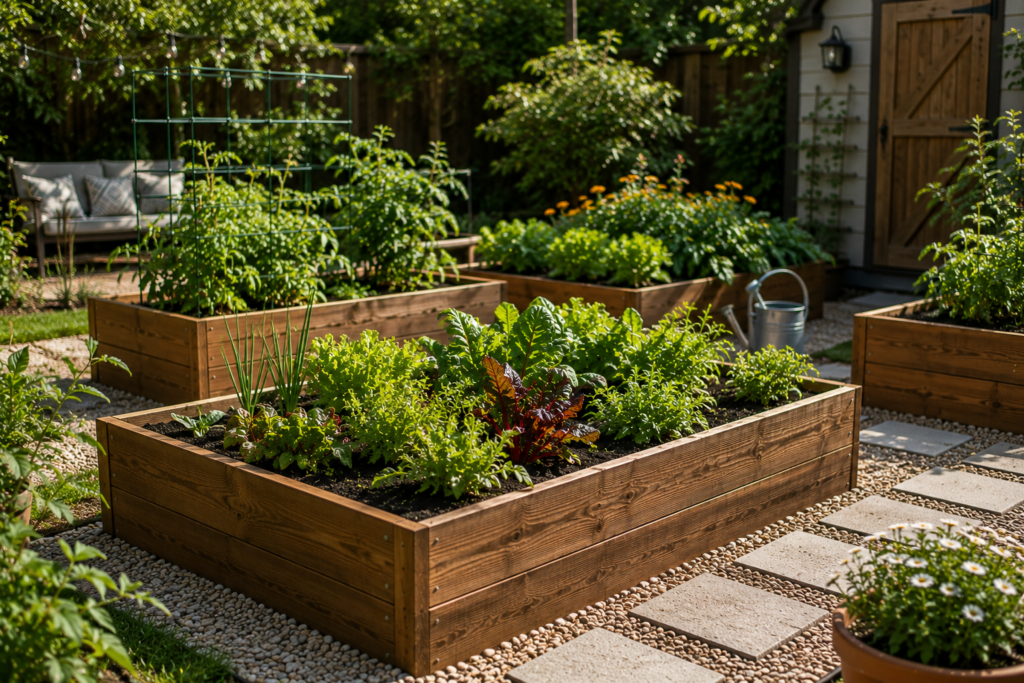
Depth matters more on concrete than it does over open soil because roots cannot continue downward into native ground.
University of Maryland Extension recommends a minimum depth of about 8 inches for leafy greens, beans, and cucumbers, while peppers, tomatoes, and squash generally need 12–24 inches when the bed sits on a hard, impermeable surface.
For a versatile backyard vegetable bed, 16–20 inches is a practical target because it provides a larger root zone and more soil to buffer moisture changes.
| Crop Type | Examples | Practical Soil Depth on Concrete | Main Consideration |
|---|---|---|---|
| Leafy greens | Lettuce, spinach | 8–12 in | Relatively shallow roots |
| Herbs | Basil, parsley | 8–12 in | Monitor moisture closely |
| Beans & cucumbers | Bush beans, cucumber | 8–12+ in | Support may be required |
| Root crops | Carrots, beets | 12–16+ in | Loose soil is important |
| Peppers | Bell peppers, chili peppers | 12–18 in | Need adequate root volume |
| Tomatoes | Determinate/indeterminate tomatoes | 16–24 in | More soil improves moisture buffering |
| Squash | Zucchini, summer squash | 16–24 in | Large plants need substantial space |
These are practical planning ranges rather than absolute biological limits; cultivar, climate, irrigation, and soil mix can change how much rooting volume a crop needs.
Drainage is probably the most important difference when building on concrete.
On natural ground, excess water can move downward. Concrete blocks that pathway, so the raised bed must provide another route for excess water to escape.
Do not create a completely sealed wooden box unless it has a properly designed drainage system.
If using a liner to protect wooden sides, keep drainage available at the bottom. University of Maryland Extension specifically recommends either making drainage openings in a liner or lining only the sides rather than sealing the base.
Water should be able to escape from the bottom edges and move away across the concrete rather than remaining trapped around plant roots.
Depending on the design, small spacers or feet can help keep wooden boards from sitting continuously in standing water.
This is particularly useful on patios where rainwater occasionally pools.
However, the structure still needs to be stable. A large, soil-filled raised bed becomes extremely heavy, so use supports that can safely carry the load and keep the frame level.
For a permanent installation, also consider where drainage water will travel before filling the bed.
Do not fill a concrete-based raised bed entirely with dense garden soil.
The growing medium needs both moisture retention and drainage.
For hard-surface beds, University of Maryland Extension recommends a 1:1 mixture of compost and soilless growing mix; for beds at least 16 inches deep, topsoil can make up as much as 20% of the mix.
This differs somewhat from beds connected to native soil. University of Minnesota Extension, for example, recommends roughly one-half to two-thirds topsoil with one-third to one-half plant-based compost for typical raised beds.
That distinction matters: a concrete-based bed functions more like a very large container.
Add the growing medium gradually and spread it evenly.
Avoid repeatedly walking on, pressing down, or heavily compacting the soil. One advantage of raised beds is reduced soil compaction because gardeners work from surrounding paths instead of stepping into the planting area.
Water the mix lightly after filling. Some settling is normal, and additional mix can be added if the soil level drops significantly.
Leave a small amount of space below the top edge so irrigation and rainfall do not immediately wash soil over the sides.
Concrete changes the moisture environment.
Unlike a conventional open-bottom raised bed, plants cannot draw moisture from native soil below. Hard surfaces can also absorb and reflect heat, increasing plant stress and soil drying. University of Maryland Extension therefore recommends checking these beds regularly and watering as needed to maintain a moist root zone.
A drip line or soaker system is usually easier to manage than frequent overhead watering. Utah State University Extension also identifies drip irrigation as an efficient option for raised beds.
Adding organic mulch after planting can further reduce evaporation.
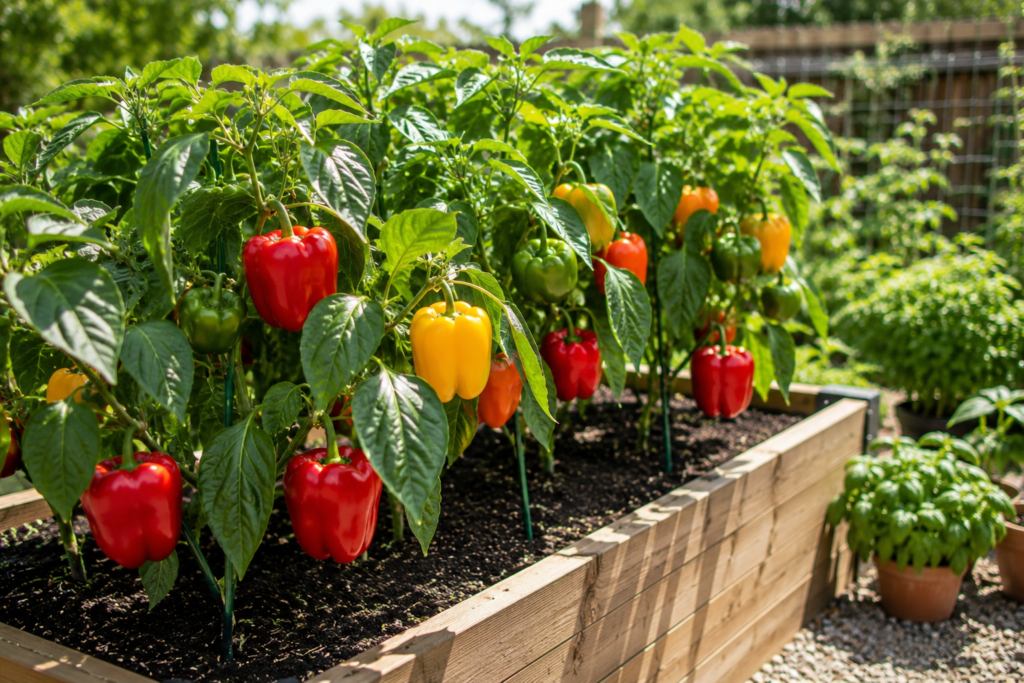
Consider what the concrete is used for before construction.
Drainage water may carry fine soil particles and organic matter onto a decorative patio. If appearance matters, design the bed so runoff moves toward an appropriate drainage area.
A protective base system can also reduce staining, but it must not prevent drainage. Avoid simply placing an impermeable sheet under the entire bed and trapping water inside.
The first major rainfall is a useful test.
Look for water remaining inside the bed, runoff collecting against the frame, soil washing out from underneath, or prolonged puddling on the concrete.
Healthy raised-bed soil should retain useful moisture while still allowing excess water to move away. University of Maryland Extension describes ideal garden soil as loose and deep, capable of holding water for roots while allowing excess rainfall to percolate quickly.
Correct drainage problems early rather than waiting until plants develop symptoms of waterlogged roots.
You can successfully build a raised garden bed on concrete, but it should not be constructed exactly like a raised bed sitting over garden soil.
The most important priorities are adequate soil depth, unrestricted drainage, a well-structured growing medium, and reliable irrigation. For a general-purpose vegetable garden, a bed around 16–20 inches deep provides considerably more flexibility than a very shallow frame.
Most importantly, think of a concrete-based raised bed as a large container garden: roots are limited to the soil you provide, and both water and drainage must be actively managed. With those fundamentals in place, a patio or concrete backyard can become a productive vegetable-growing space.